Unilever
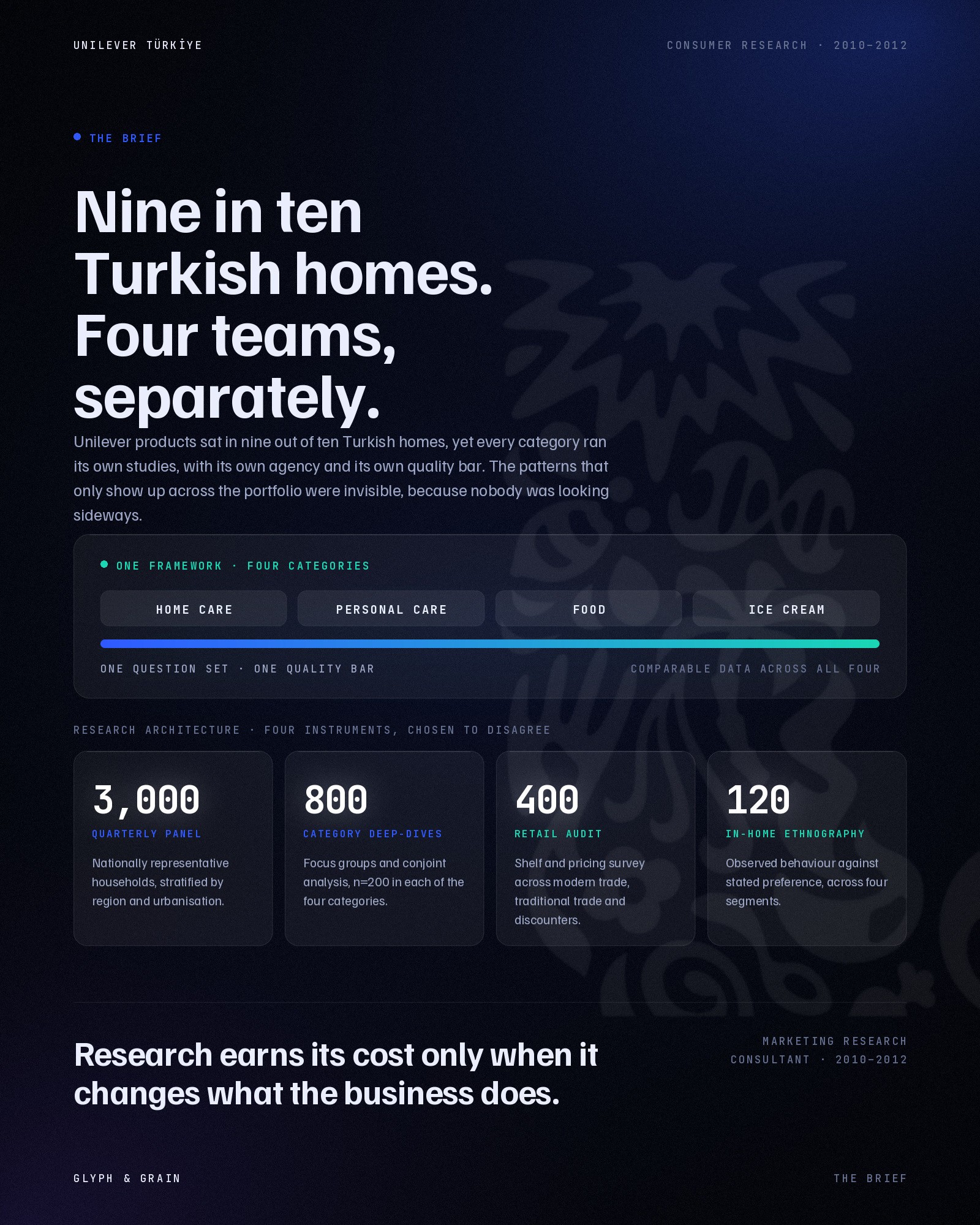
Unilever products sat in nine out of ten Turkish homes. Personal care, home care, food and ice cream all sold well, and every one of them ran its own research: its own agency, its own methodology, its own quality bar. Findings stayed inside the category that commissioned them. The patterns that only appear across a portfolio, how Turkish families were starting to shop and where brand loyalty was quietly thinning, were invisible because nobody was looking sideways.
The engagement had three jobs, in order. Scope it, so a single research architecture ran across all four categories and a finding in one could be stress tested against the other three. Prove it, so quality checks caught bad data before it reached a category team and shaped a product decision. Then translate it, so every finding arrived with a recommendation attached rather than a request for further investigation.
The instrument set was chosen so the instruments would disagree with each other. A 3,000 household quarterly panel says what people bought. Category deep dives with 800 respondents say what they will pay for. A 400 store retail audit says what was on the shelf when they decided. And 120 in home ethnographic sessions say what they actually do with the product once it is home. Where the sources contradicted each other was usually where the finding was.
Deliverables
Research framework
Portfolio segmentation
Behavioural analysis
Data quality assurance
Category recommendations
Date
2010-2012
Client
Unilever
Industry
Consumer goods
One framework across four categories, a quality gate in front of every study, and a rule that no finding leaves the room without a recommendation attached to it.

The market the portfolio was selling into. Rising incomes enabled premium trade-up while discounters strengthened private label.
Five ways of shopping, three strategic postures. Five shopper profiles gave every category team one shared consumer language.
Five behavioural patterns that travelled across the portfolio. Portfolio patterns revealed a price ceiling, stronger sampling, frequent trips, pack-size loyalty, and a trust gap.
Six thresholds, each with a consequence written next to it before fieldwork began. Clear thresholds governed data quality, evidence strength, fieldwork timing, and delivery.
Six trends written into the questionnaire as signals, not conclusions. Modern trade, daily shopping, premiumisation, loyalty shifts, and regional differences were treated as signals.
What consumers said, against what the data showed. Panel and retail data exposed the stronger roles of promotion, shelf position, habit, and availability.
The quality gate. Every study passed bias, cleaning, consistency, and actionability checks before release.
Twenty eight weeks to a repeating cadence. A 28-week cycle repeated scoping, fieldwork, ethnography, delivery, and synthesis.


The programme's value was not a number, it was a shared language. Four categories that had been describing four different Turkish consumers were now describing the same five segments with the same evidence behind them, which meant a shift observed in ice cream could be read against home care in the same week it appeared. The gap between what consumers said and what they did stopped being an awkward footnote in a deck and became the place the marketing opportunity was expected to be found.
Three findings changed budget lines directly. The 15 percent ceiling gave pricing a defensible line in the categories most exposed to private label. The sampling to advertising efficiency ratio said the split between above the line and in store activation was inverted. And freezer share, not brand preference, turned out to predict ice cream category share, which reframed what ice cream marketing spend was actually buying.
Research only earns its cost when it changes what the business does. That was the rule the quality gate and the actionability filter existed to enforce, and it is why every finding left the room with a recommendation attached to it. Figures are as recorded at the time of the engagement.
Unilever
Marketing research consultant, 2010 to 2012