Garanti BBVA
Every major bank in Turkey ran a graduate programme, so having one was never the advantage. In 2010 BBVA took its stake in Garanti and the bank moved into a growth phase that depended on hiring well and keeping people. The brief was to design and audit a skills training programme that strengthened the employer brand and actually fed the talent pipeline.
The programme was losing people before it could develop them. A graduate intake of 120, a twelve-month retention rate of 60 percent, and two thirds of the loss happening inside the first ninety days, which is the phase the programme controlled most tightly. Garanti, İş Bankası, Akbank, Yapı Kredi and the international players were all recruiting from the same pool of top business and engineering graduates. The differentiator was never the existence of a programme. It was whether the programme worked as a pipeline, or just processed cohorts.
Three jobs, in order. Diagnose where the leak actually was rather than where it was assumed to be. Rebuild the phase that was causing it. Then audit the rebuilt programme against the previous cycle at four fixed intervals, so the claim could be checked rather than asserted.
Deliverables
Programme diagnosis
Curriculum architecture
Engagement design
Employer brand positioning
Retention audit
Date
2010
Client
Garanti BBVA
Industry
Banking
The phase that had been destroying engagement became the one participants rated most valuable, and nothing about the branches changed.

The diagnosis. Programme scores revealed a clear mid-journey drop: branch rotation lacked the structure, support, and ownership of the classroom phase.
Four phases, rebuilt around the phase that was leaking. The rebuild combined a stronger Garanti-specific orientation, weekly skill checkpoints, practical simulations, peer mentors, and cross-functional teams.
Five mechanisms in the engagement layer. Peer mentors, cohort identity, leadership access, career visibility, and weekly pulse checks made the programme more likely to retain talent.
The mechanism, confirmed at exit. The redesign did not retain people who wanted to leave; it stopped the programme itself from becoming the reason they left.

Three failures, one of them structural. Most attrition happened in the first 90 days, feedback arrived too late, and generic recruitment messaging failed to show why Garanti was distinct.
The rotation redesign. Rotation gained clear weekly outcomes, regular cohort check-ins, and one accountable coordinator—removing the isolation behind disengagement.
The audit, measured at four intervals. Retention, rotation satisfaction, completion, advocacy, and target-role movement all improved at the 30-day, 90-day, six-month, and annual checkpoints.


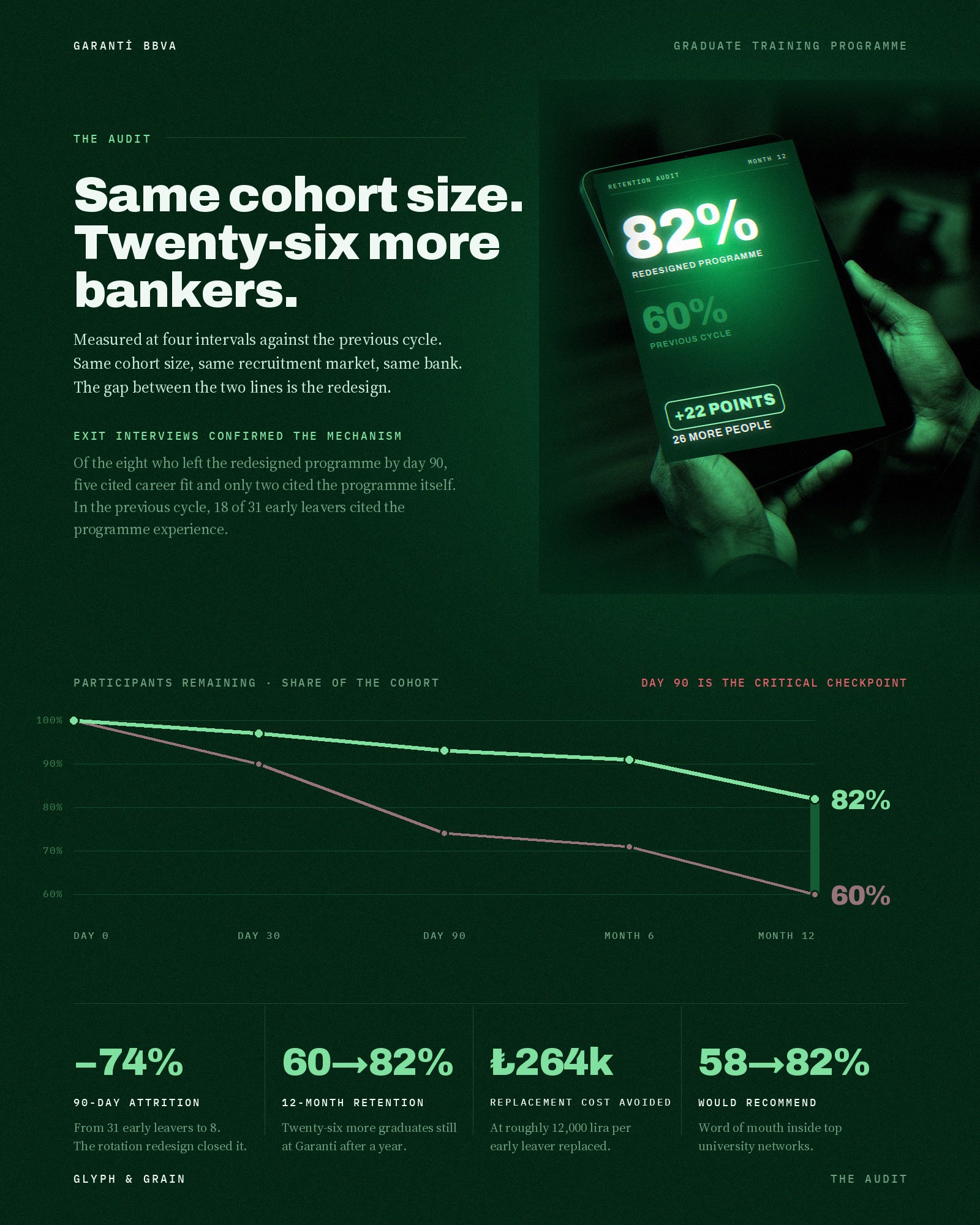
Ninety-day attrition fell 74 percent, from 31 early leavers to 8. Twelve-month retention moved from 60 to 82 percent, which is twenty-six more graduates still at the bank a year later from an identical intake of 120. Replacement cost avoided came to roughly 264,000 lira at 12,000 lira per early leaver, though the downstream value was larger, because those people were in roles and building capability rather than being re-recruited. Would-recommend-to-a-peer went from 58 to 82 percent, and word of mouth inside top university networks became the most credible recruitment channel for the next cohort.
The phase that had been destroying engagement became the one participants rated most valuable. Branch rotation went from 2.9 to 3.7. Structure gave the rotation a purpose and the check-ins gave it a community. Nothing about the branches changed. Figures are as recorded at the time of the engagement.
Garanti BBVA
Marketing strategy and audit consultant, 2010