Turkcell
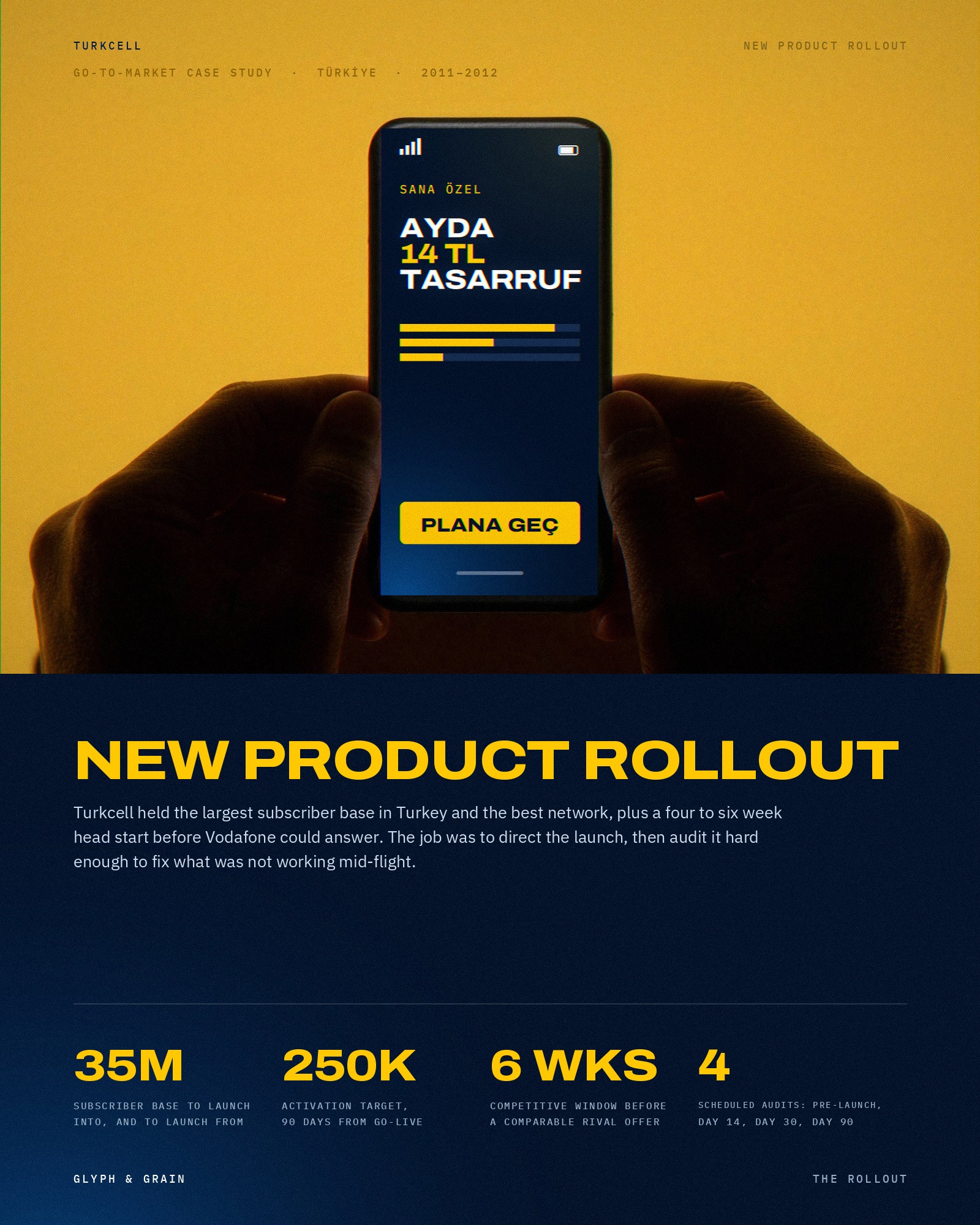
Turkcell held the largest subscriber base in Turkey and the best network, plus a four to six week head start before Vodafone could answer. The job was to direct the rollout of a new product, then audit it hard enough to prove what was working and fix what was not, mid-flight rather than post-mortem.
The brief came with four numbers attached: a 35 million subscriber base to launch into and to launch from, an activation target of 250,000 within 90 days, a competitive window of roughly six weeks, and four scheduled audits at pre-launch, day 14, day 30 and day 90.
In a three-player market, awareness alone does not move a launch. Vodafone was buying share through pricing wars and Avea was growing on aggressive prepaid offers, so launching meant landing the right message on the right segment before either could respond. The approach was segmentation-led: channels were selected against the segments rather than the other way round, and the measurement loop was built into the launch from day one.
Deliverables
Segmentation
Message testing
Channel architecture
Launch direction
Performance audits
Date
2011-2012
Client
Turkcell
Industry
Telecom
A segmentation-led rollout with the measurement loop built in from day one, so the budget could follow the evidence instead of the plan.

The market at launch. Data was the growth opportunity, but smartphones were still limited. The launch had to serve both data-ready users and a much larger feature-phone market.
Five segments, ranked by propensity rather than size. Digital early adopters launched first, postpaid mainstream followed on social proof, and high-value prepaid users became the migration opportunity. Mass prepaid stayed low priority.
Channels entered the plan with a declared job. Broadcast built reach, owned channels personalised conversion, and retail captured the data needed to see what prompted each activation.
Competitive position. Turkcell led on scale and network quality, while Vodafone was expected to answer quickly on price. The message therefore shifted from novelty to superior value after launch.
Messaging, tested before a lira went on media. Three message routes were tested before media spend: one led broad awareness, one performed in digital, and one served the migration audience in phase two.
Three phases, each written by the last. A test phase seeded the highest-propensity audience, six weeks of scale built momentum, and the final phase optimised for migration.


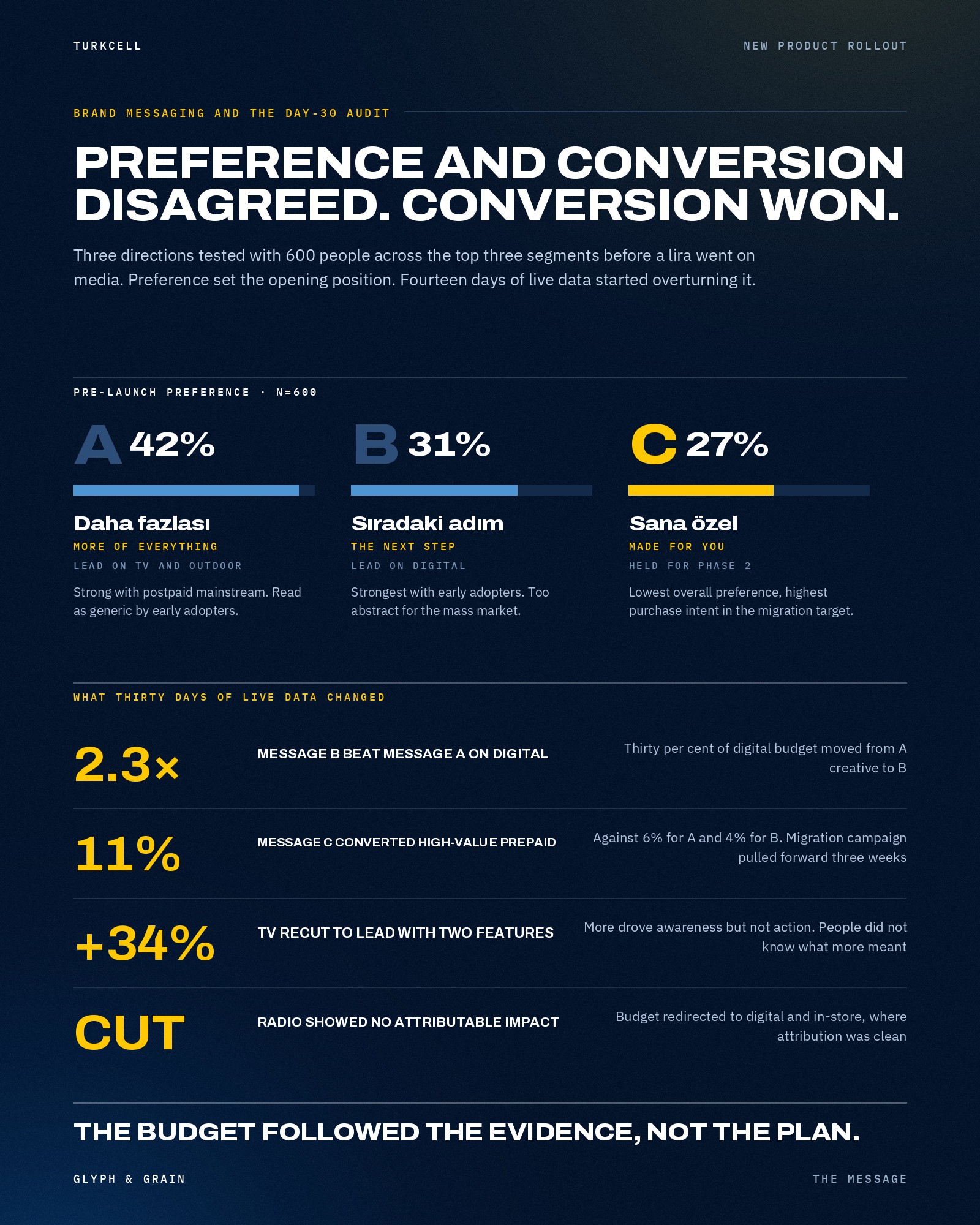

Preference and conversion disagreed, and conversion won. Message B beat Message A on digital by 2.3 times, so 30 percent of digital spend moved from A creative to B. Message C converted high-value prepaid at 11 percent against 6 for A and 4 for B, so the postpaid migration campaign was accelerated by three weeks and C became the lead for in-store and CRM. The TV creative was recut to lead with two specific features rather than a generic promise of more, and conversion rose 34 percent by week six. Radio showed no attributable impact on either awareness or conversion and was cut entirely, with the budget redirected to digital and in-store.
At day 14, early adopter conversion came in at twice target while postpaid mainstream lagged at 4.2 percent against an 8 percent goal, and in-store drove 40 percent of week-one activations on 15 percent of budget, which moved 20 percent of the TV maintenance budget into additional mall pop-ups. The day 90 audit did not ask whether the launch was successful. It asked which decisions were right, which were wrong, and what to do differently. A launch is a hypothesis and the audit is the experiment. Figures are as stated in the source brief.
Turkcell
Go-to-market lead, 2011 to 2012